Reflexive and Reflective Practice in Research Through design (RtD)
Reflexive practice and Reflective Practice - What do these two terms mean and what’s the difference? And why am I embarking on this journey on my PhD research?
It is funny because trying to determine what the academic definition of reflexive and reflective practice in art and design is actually a difficult thing. I am not sure if they can be defined as research methods in their own right though they can provide a lot of insight into any research project.
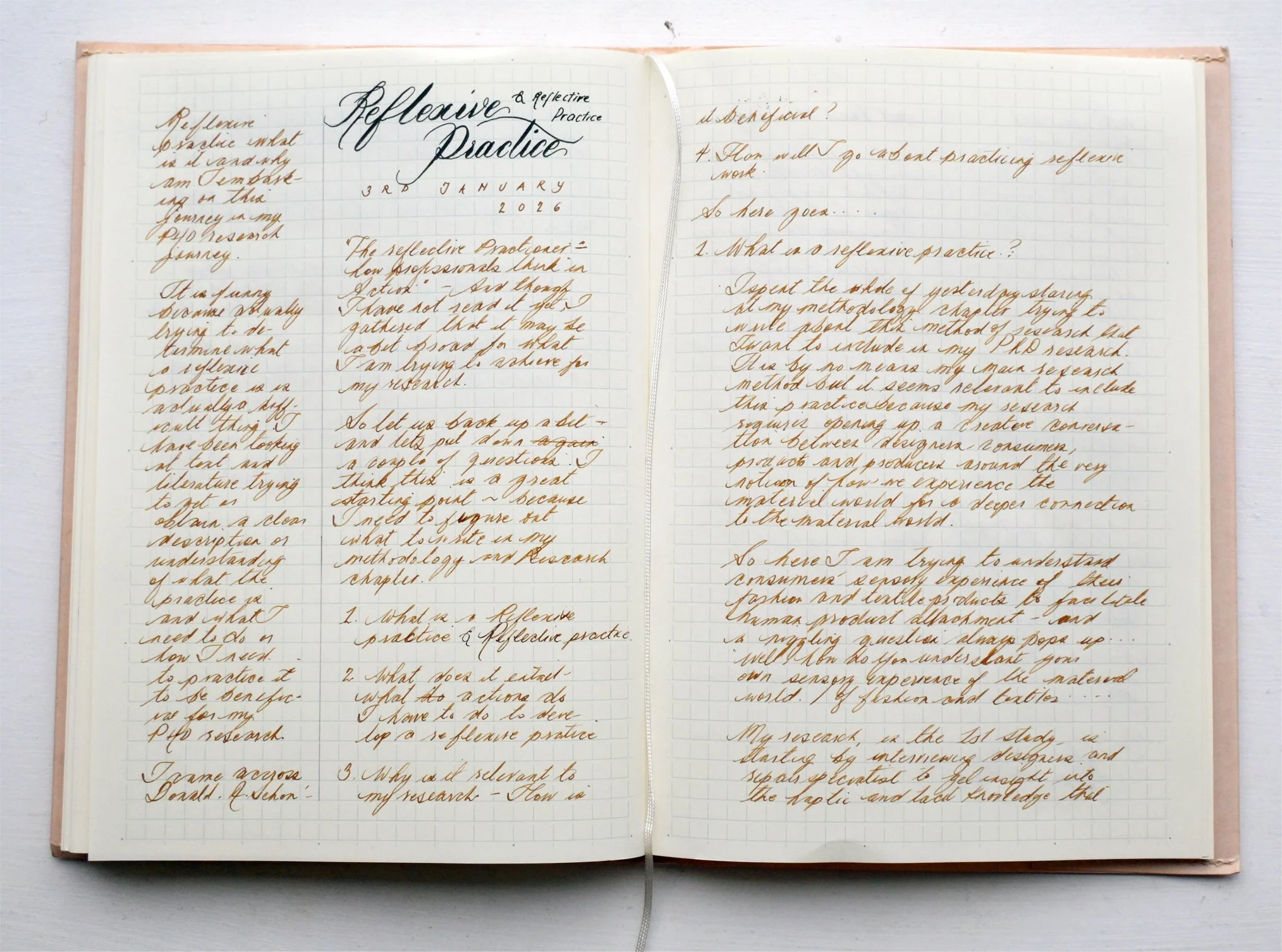
I have been looking at texts and literature trying to obtain a clear description or understanding of what these practices are and what I need to do or how I need to practice them to be beneficial for my PhD research. I came across Donald A. Schon’s, ‘The reflective practitioner - How professionals think in action’ (2017), and though I have not read it yet, I gather that it may be a bit broad for what I'm trying to ascertain for my research. So let us back up a bit, and let’s put down a couple of questions. I think this is a great starting point, because I need to figure out what to write in my methodology and research chapter regarding these two practices.
What is reflective practice and what is reflexive practice?
1. What is reflective practice and what is reflexive practice?
2. What do they entail? What actions do I have to do to develop a reflective and reflexive practice?
3. Why is it relevant to my research? How is it beneficial?
4. How will I go about practising reflexive or reflective practice?
So here goes.
What is a reflexive practice and a reflective practice? I spent the whole of yesterday, staring at my methodology chapter, trying to write about these “methods of research” that I want to include in my PhD thesis - in quotes because I am not too sure if they are methods. They are by no means my main research methods, but it seems relevant to include this practice, because my research requires opening up a conversation between designers, consumers, products and producers around the very notion of how we experience the material world for a deeper emotional connection to materials. So here I am trying to understand consumers’ sensory experience of their fashion and textile products in order to facilitate human product attachment but a niggling question always pops up.
Well, how do you understand your own sensory experience of the material world; of fashion and textiles? My first study, which is looking at Repair as a sensory experience, is starting by interviewing designers and repair specialists to get an insight into the haptic and tacit knowledge that designers and makers have or experience each day when they interact with the materials they use in their practice. These interviews act as a means to gather semantics for material experience - this is because sensory material experiences are usually hard to describe. Those hard to describe sensory experiences is what you would call tacit knowledge.
I plan on taking these insights to design a sensory repair toolkit and a series of prototypes to test on consumers or participants to see if these sensory repair experiences and the affects from these experiences will increase and enhance their emotional bonding to the textiles and fashion products they already have.
But what about me as a designer and researcher? What do I feel, when I design and develop these textile or repair prototypes? I will be also be engaging in textile repair practises or methods, most of which I am no expert in - and where I have to find words or linguistically describe in a clear manner, my own feelings and sensory experiences in order to form a narrative around these creative processes and materials. In some way, I am like my participants who have no technical expertise in textile repair methods - though I have the upper hand of being a maker and used to dealing with textiles, materials and similar making processes. Therefore I have to ask the following questions…
Does having tacit knowledge influence our connection to materials - are we biased because we are makers ? How do I describe these experiences? Are they purely subjective? If there are clear descriptions or particular words to describe a sensory experience of a particular material, can these sensory experiences and affects be reproduced across various users?
So what is reflexive practice? What is reflective practice? Yesterday, I looked at a few methods, including design ethnography, empathy maps, diary studies and photo studies to name a few. It seemed to me that all these methods, or what I like to call mini methods, are relevant in the approach that I am using to carry out my research, i.e; Research through Design (RtD). However, these mini methods express an empathy towards the participant’s experience, which is 100% relevant to my research. But another practice that is relevant in Research through Design is the art of journalling. In RtD, I am “required to integrate models and theories with technical knowledge in the design process” - Zimmerman et al, ‘Research through design as a method for interaction design’, (2007). It also requires that I document these processes. So how do I go about doing that?
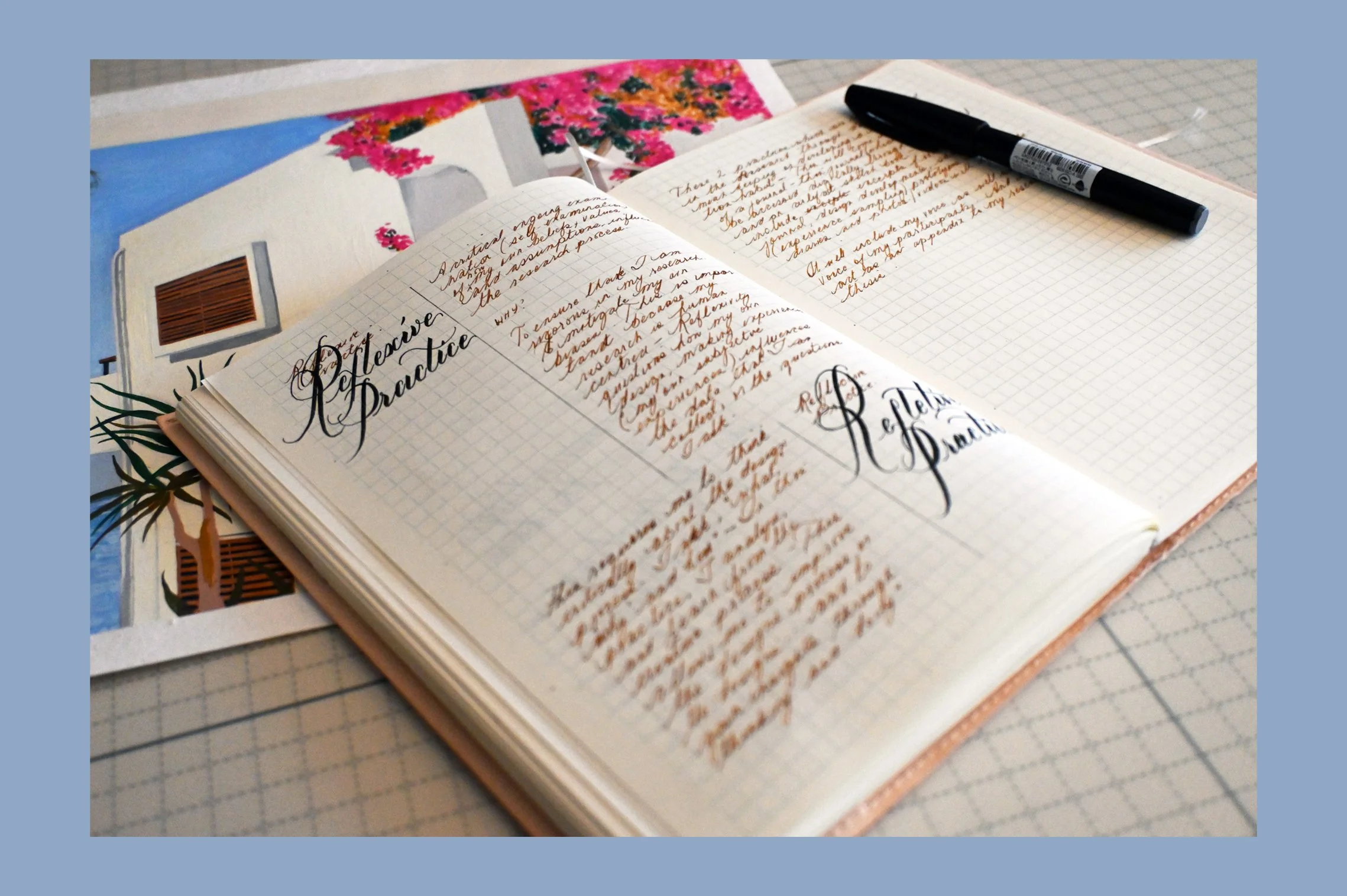
Let's look at reflexive practice to begin with. Reflexive practice is a critical ongoing examination, or self examination of how my own beliefs, values, and assumptions influence the research process. It is done to ensure that I am rigorous in my research, to mitigate my own biases. This is important because my research is human-centred. Reflexivity questions how my own design making experiences, my own subjective experiences, influences the data I collect or the questions I ask. Reflexive practice, perhaps aligns itself to the interpretivist research paradigm which my research falls under.
When it comes to reflective practice, this requires me to think critically about the design process. I ask, what, why, and how? In this practice, I analyse and learn from the creative process. This allows me to improve the design process or the designed prototypes, and to gain insight through thinking and doing. Reflective practice aligns itself to the constructionist research paradigm which my research also sits under.
These two practises, which are relevant in the RtD method, means developing a documentation habit. In my case, this will come in the form of a journal in both physical and digital format - the digital format can be accessed through my website. I will also keep an artefact sketchbook, which will include excerpts from my journal, design developments, experience sampling, participant feedback, prototypes, diaries, photos and videos with hyperlinks. It will include my voice (as a designer and researcher) as well as the voice of my participants (as consumers). And it will act as an appendix to my research thesis. Reflexive practice and reflective practice go hand in hand. I cannot separate the two, and indeed they cannot be separated from my research.
This article forms part of a series called the reflec(tive) + (xive) practice - a method I am using in the first study of my research called “Repair as a Sensory Experience”. It aims to establish a commentary on my findings as a maker, researcher and observer as I gather data from designers and repair specialists, consumers and my own design and making process. It acts as a means to understand the experiences of my research participants or my target audience by reflecting on my own experiences. Along with my research, it also provides insight on what strategies I can adopt to facilitate emotionally durable human-product attachment.
Reflexive writing - (of a method or theory in the social sciences) taking account of itself or of the effect of the personality or presence of the researcher on what is being investigated.
Reflective writing - Writing reflectively involves critically analysing an experience, recording how it has impacted you and what you plan to do with your new knowledge. It can help you to reflect on a deeper level as the act of getting something down on paper often helps people to think an experience through. Involves ‘thinking and doing.’ Reflective writing is - Written in the first person; Analytical; Free flowing; Subjective; A tool to challenge assumptions; A time investment.